
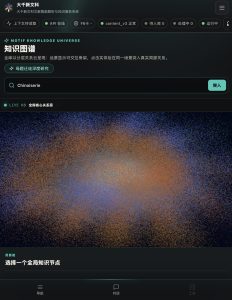
NetDragon has partnered with the College of Fine Arts of Fujian Normal University (“FJNU”) to develop “Daqian,” a large AI model designed to support the New Liberal Arts. Its capabilities span cross-language literature review, visual analysis, source verification, and manuscript drafting. The teams, led by Professor Huang Zhongjie at FJNU College of Fine Arts and Dr. Liu Dejian, Founder and Chairman of NetDragon, combined the college’s academic expertise with NetDragon’s engineering capabilities. “Daqian” brings together a specialized knowledge base, multimodal understanding, retrieval-augmented generation, knowledge graphs, and multi-agent collaboration in a single platform for processing source materials, supporting academic research and organizing research outputs. The platform is now in internal trials. It contains approximately 22.4 million text passages, 750,000 images and has generated approximately 11.6 million vectors for search.

Joint Development of “Daqian” to Strengthen the Foundation of Academic Research
“Daqian” uses multimodal document parsing and visual recognition to process text, tables and images from academic papers, monographs and scanned archives. It preserves the link between each item and its original page so researchers can check details such as names, dates, units of measurement and features in an image. Cross-modal semantic embeddings allow researchers to search text and images together. For example, a researcher can describe an image in words, find relevant images and compare them with written accounts and source records.
The platform combines keyword matching and semantic search to find materials across languages. Through retrieval-augmented generation (RAG), it draws on relevant source materials to provide contextually grounded responses. Its knowledge graphs connect people, institutions, concepts and publications, helping researchers follow leads and trace sources. The platform also uses the Citation Typing Ontology (CiTO) to identify whether a cited work supports, challenges, revises or extends an earlier argument, helping researchers trace scholarly debates and identify points of disagreement.
Integrating AI Technologies to Support Material Retrieval and Evidence Verification
“Daqian” dynamically coordinates its “Research Assistant” agents, allowing researchers to use natural language to ask questions, add materials or refine tasks. Through the Model Context Protocol (MCP), “Daqian” calls on tools for search, source-text review, image comparison and evidence verification as needed. These tools help researchers find source materials, draft manuscripts and verify their findings. “Daqian” retains source locations, lets researchers return to the original text and uses deterministic checks to help verify that quotations match their sources. Researchers can consider where and when a source originated and read it in context before deciding whether it supports an argument. They can also compile their work in progress into documents with footnotes and citations for later review.
Deepening University-Industry Collaboration to Advance Interdisciplinary Research and Talent Development
Building on these trials, FJNU College of Fine Arts plans to pilot “Daqian” in teaching, with assignments centered on close reading, image comparison and research projects. Working on specific research questions, students will practice assessing the reliability of sources, explaining which evidence they chose to use and why, and documenting how their arguments change as new evidence emerges. By translating the college’s academic research requirements into software functionalities, the collaboration has transformed complex scholarly workflows into practical tools for research and teaching.
NetDragon and the college will continue to refine “Daqian” and expand its library of case studies. They will also explore how their joint development approach could be applied to emerging areas of engineering, medicine, agriculture and the arts. Drawing on NetDragon’s experience in AI research and engineering, the teams will consider each field’s research methods, source materials and teaching needs as they develop tools for specific academic tasks and build a wider range of case studies for interdisciplinary research and student training.